When a bicycle, trailer, or vehicle needs greater nighttime visibility, small reflective frame stickers can offer a practical solution. These thin adhesive labels use retroreflective material, which returns light toward its source. A headlight beam strikes the surface. The sticker then appears bright to the approaching driver. It does not produce light independently. That distinction matters.
Reflective frame stickers are commonly applied around license plates, safety frames, equipment panels, or bicycle components. Their performance depends on clean surfaces, firm pressure, correct placement, and a suitable viewing angle. Dust, water, peeling edges, and heavy scratches can reduce their brightness. Poor installation can create false confidence. The brightest material still fails when hidden behind mud or luggage. In practical testing, visibility should be checked from several distances and directions, not only under a phone flash. This simple step often exposes weak adhesion or uneven coverage.
This article explains the materials, optical principle, installation process, and maintenance habits behind these stickers. It also separates useful visibility support from exaggerated advertising claims. Product quality varies. Some labels fade quickly, while others remain readable after weather exposure. Buyers should examine measurements, adhesive information, durability testing, and supplier transparency. Local rules may also affect where reflective markings can be placed, so responsible use requires checking applicable guidance. Reflective frame stickers can improve recognition, but they cannot replace lights, safe riding, or attentive driving. They are helpful, not magical. Understanding their limits leads to better decisions and more reliable safety practices.
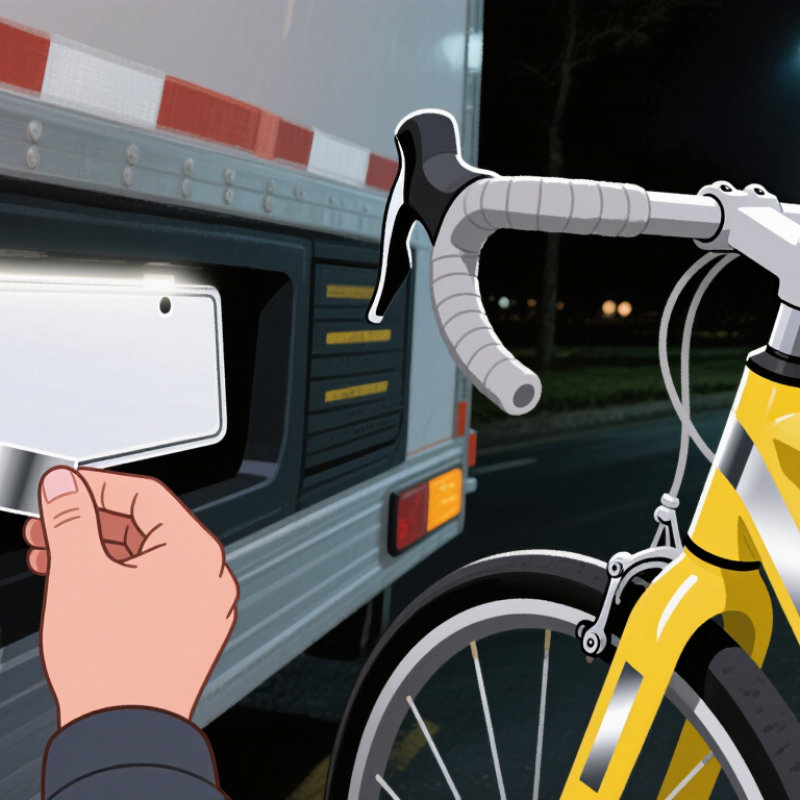
Reflective frame stickers use a thin retroreflective film, not ordinary silver paint. Its microscopic glass beads or prismatic cells return headlight energy toward the driver. The effect appears strongest at night, when a light source sits near the observer. The adhesive matters just as much. A pressure-sensitive layer must bond to a clean, dry frame without trapping dust or moisture. In practice, fingerprints and cold surfaces can cause early edge lifting. I have seen a sticker look bright at installation, then weaken after repeated washing. That detail is easy to miss.
ASTM D4956 provides a useful technical reference for retroreflective sheeting. It evaluates photometric performance, color, weathering, adhesion, and dimensional stability. However, ASTM D4956 does not automatically certify every small frame sticker. Film class, observation angle, entrance angle, and surface condition affect measured brightness. A product claiming ASTM D4956 alignment should identify its tested sheeting type and performance conditions. That evidence matters more than the word “reflective.” NHTSA’s 2022 Traffic Safety Facts recorded 7,522 pedestrian deaths in the United States, with most occurring in darkness. Reflective details can improve conspicuity, but they cannot replace lamps, clean surfaces, or responsible road behavior. The limitation is real. Retroreflection is directional.
Reflective frame stickers are thin visibility aids placed on bicycle, vehicle, or equipment frames. Their reflective layer does not create light. It redirects incoming light back toward the source, such as a headlamp. This effect is called retroreflection. A driver may then see a bright outline instead of a dark shape.
Glass bead stickers use tiny spherical beads above a reflective backing. When light enters a bead, it bends, reaches the backing, and returns through the bead toward the lamp. The result resembles many small points of light. Microprismatic stickers work differently. Their molded surfaces contain precise angled facets that fold light back toward their source. They often provide stronger reflection across selected viewing angles, but performance still depends on alignment.
In practical checks, surface preparation matters more than many people expect. Dust, water, wrinkles, and sharp frame curves can interrupt the reflective pattern. I once assumed a larger sticker would always improve visibility. That was too simple. Placement near the front, side, and rear can create a clearer moving outline, especially when the light approaches from different directions. Reflective material also needs regular inspection. Scratches and peeling edges reduce its effective area. It is not magic. It cannot replace active lights, and bright results may weaken in fog, rain, or extreme angles. A reliable test uses a lamp at eye level, a dark setting, and several viewing distances.
Reflective frame stickers use glass beads or microprisms to redirect incoming light toward its source. This effect is called retroreflectivity. A vehicle headlamp can illuminate the sticker, while the driver sees a concentrated return signal. The result is directional.
Retroreflectivity is commonly reported in cd/lx/m². This unit describes luminous intensity returned toward the observer for each unit of illuminance on the material. A testing device sends controlled light onto the sticker, then measures the reflected light. The instrument records both observation angle and entrance angle. Observation angle is the angle between the light source and detector. Entrance angle describes how the light strikes the surface. Small angle changes can affect the reading significantly.
Testing at standard angles creates useful comparisons. A 0.2° observation angle can represent a distant driver viewing a near-aligned surface. Wider angles may represent a closer vehicle or an offset viewing position. Test results also depend on color, surface texture, adhesive alignment, and material age. Clean the sample. Dust can reduce measured performance. Moisture may create another variable.
In practical inspections, the sticker should be mounted flat and measured under controlled conditions. Inspectors should record its orientation, temperature, and cleaning method. A common mistake is treating one high reading as permanent proof of performance. It is not. Measurements can vary between instruments, and field conditions are rarely perfect. That limitation deserves careful reporting.
What Are Reflective Frame Stickers and How Do They Work?
Reflective frame stickers return light toward its source. Tiny glass beads or microprisms redirect vehicle headlights toward the driver. This creates a bright outline around a vehicle, trailer, or frame at night. The effect is called retroreflection. It is not the same as ordinary shine.
Under ECE R104, RA1, RA2, and RA3 describe increasing reflective performance. RA1 offers the basic level for visibility. RA2 provides stronger retroreflection at wider viewing conditions. RA3 represents the highest performance level in this range. Testing considers factors such as observation angle, entrance angle, color, and the coefficient of retroreflection. A sticker may look bright in daylight but perform poorly during an angled approach. That difference matters.
The standard can feel technical. Real roads are less tidy. Dust, rain, scratches, and poor application can reduce the result. I have found that a clean surface often matters more than expected. The label should also match the approved specification, not just the visible color.
Tips: Check the ECE marking and class information before installation. Clean and dry the frame completely. Avoid placing stickers over seams, rust, or sharp bends. Inspect them after washing and after long exposure to sunlight. RA3 sounds best, but the correct class depends on the approved vehicle application and installation design.
Reflective frame stickers use retroreflective materials to return vehicle headlights toward the driver, making marked surfaces more visible at night. Under ECE R104, higher classes indicate stronger retroreflection. At the reference geometry of a 0.33° observation angle and a 5° entrance angle, the minimum coefficient of retroreflection for white material is 70 cd/lx/m² for RA1, 100 cd/lx/m² for RA2, and 150 cd/lx/m² for RA3.
Reference basis: ECE R104 minimum photometric requirements for white retroreflective marking materials. Actual performance also depends on observation angle, entrance angle, color, surface condition, and installation.
What Are Reflective Frame Stickers and How Do They Work?
How UV Exposure, Weather, and Surface Preparation Affect Service Life
Reflective frame stickers use tiny glass beads or prismatic structures to return light toward its source. This effect improves visibility at night and in poor weather. Their performance depends on more than reflective material. Adhesive condition, installation temperature, and surface cleanliness also matter. In practical inspections, stickers often fail at the edges first. That small detail can reveal a larger preparation problem.
Ultraviolet exposure gradually weakens the printed surface and may reduce color contrast. Strong sunlight can make a sticker look dull before the reflection noticeably changes. Rain, snow, dust, and repeated freezing can stress the adhesive. Water may enter through lifted corners. High heat can soften the adhesive, while cold can make it less flexible. Service life varies widely because local climate and cleaning habits are different.
Surface preparation is the part people rush.
The application area should be dry, smooth, and free from oil, wax, loose paint, and dust. A mild cleaner may help, but residue must be removed completely. Rough or rusty frames can create tiny air channels beneath the sticker. Firm pressure helps the adhesive contact the surface evenly. Installation during extreme temperatures is not ideal. I have learned that a clean-looking surface is not always ready. A short inspection under bright light can reveal scratches, bubbles, or weak edges. Those defects deserve attention before weather turns them into larger failures.
It measures returned light intensity for each unit of incoming illuminance. The result describes retroreflective performance. Higher readings usually indicate stronger return toward the observer.
A testing device sends controlled light onto the sticker. It then measures the returned light. The instrument records observation angle and entrance angle. Small angle changes can alter the reading significantly.
Standard angles make results easier to compare.
These classes describe increasing reflective performance levels. RA1 provides a basic visibility level. RA2 offers stronger performance under wider viewing conditions. RA3 represents the highest level within this group. The correct class depends on the approved application.
Yes. Daylight appearance does not prove night-time performance. An angled approach can produce a weaker result. Color, surface texture, and material age also affect readings. Looks can mislead.
Make the surface dry, smooth, and free from oil or wax. Remove dust, loose paint, and cleaner residue. Avoid rusty areas, seams, and sharp bends. Press the sticker firmly across its surface. Clean-looking is not always ready.
Ultraviolet exposure can weaken printed surfaces and reduce color contrast. Rain, snow, dust, and freezing temperatures stress the adhesive. Heat may soften it. Cold may reduce flexibility. Water can enter through lifted corners.
Record orientation, temperature, cleaning method, and test angles. Keep the sticker flat during measurement. Remove dust and moisture before testing. Do not treat one high reading as permanent proof. I made that mistake once.
Reflective frame stickers are thin films designed to improve the visibility of frames, panels, and other surfaces by returning incoming light toward its source. They typically combine a durable reflective layer, pressure-sensitive adhesive, and protective surface coating. Common technologies include glass beads and microprisms: glass beads bend and reflect light through rounded elements, while microprisms use precise geometric surfaces to redirect light more efficiently. Materials may be evaluated under standards such as ASTM D4956, which describes performance and construction requirements for retroreflective sheeting.
Retroreflectivity is commonly measured in candelas per lux per square meter (cd/lx/m²) at defined observation and entrance angles. Under ECE R104, classes RA1, RA2, and RA3 indicate increasing levels of reflective performance for approved applications. The sticker’s service life depends on ultraviolet exposure, rain, temperature changes, abrasion, and surface preparation. A clean, dry, smooth, and properly prepared surface helps the adhesive bond securely, while regular inspection can identify lifting, fading, or damage before visibility is reduced.